Invisible watermarks for images follow three very different paths: classic frequency-domain blind watermarks, deep-learning watermarks, and C2PA metadata signatures. They resist different attacks, allow different customization, and are verified by different parties. Wrong choice means watermark gone after a screenshot—or you can't read the copyright info you need. This article clarifies the tradeoffs.
What Are the Main Invisible Watermark Routes?
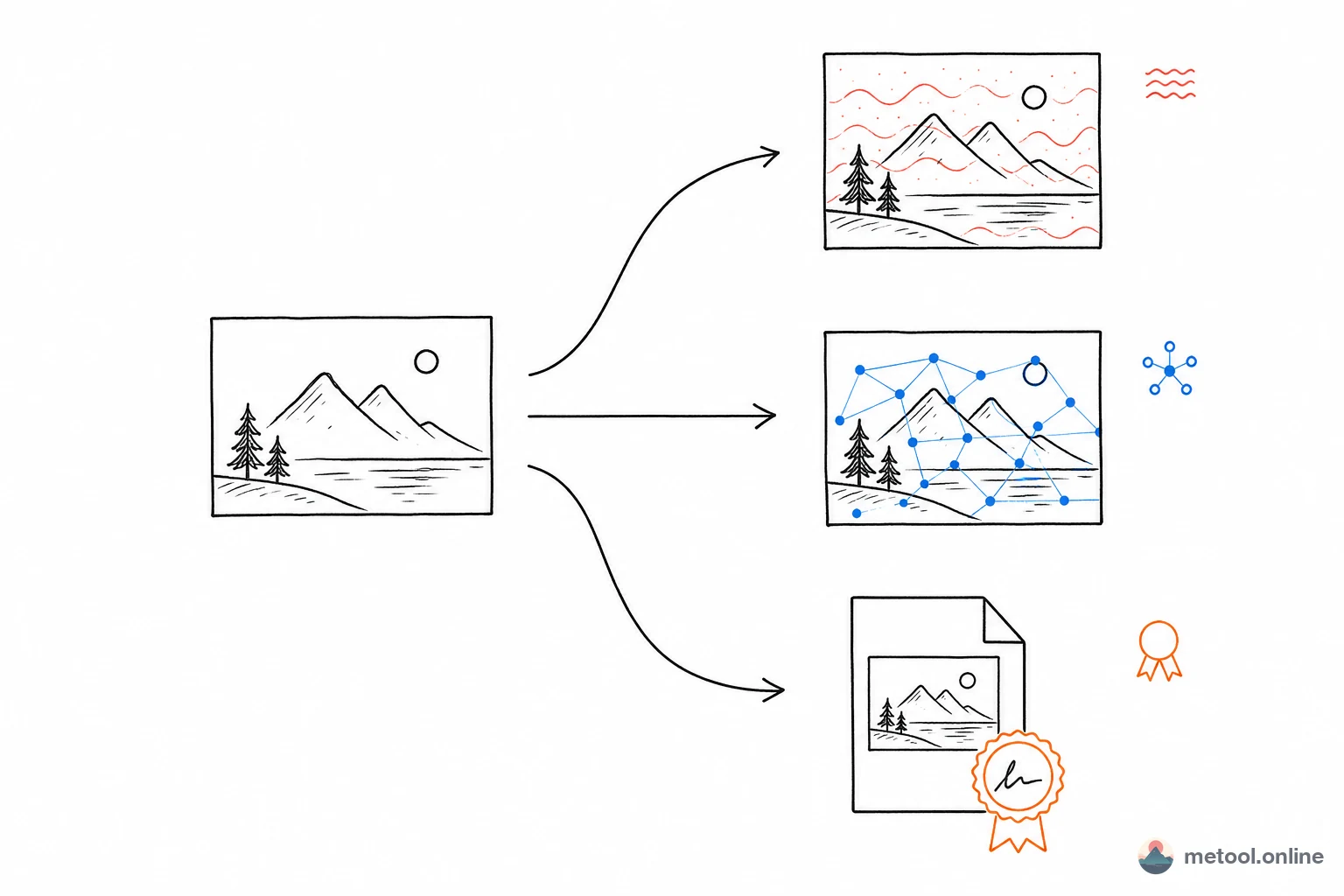
Three categories: frequency-domain blind watermarks (hide info in frequency coefficients), deep-learning watermarks (neural nets spread signal across the image), C2PA metadata signatures (cryptographically signed provenance in file metadata). All aim to mark source without visible quality loss—but mechanisms and limits differ sharply.
Overview:
| Approach | Examples | Embedding | Who verifies | Custom text/password |
|---|---|---|---|---|
| Frequency blind watermark | DWT-DCT-SVD | Fixed frequency coefficients | Any tool implementing the algorithm | Yes |
| Deep-learning watermark | SynthID, Pixel Seal | Neural net, full-image | Official/model decoder only | Mostly no |
| Metadata signature | C2PA | File metadata + crypto signature | C2PA-aware software | Standard fields |
Knowing which class a tool belongs to tells you what it can and can't do.
Frequency-Domain Blind Watermarks: Strengths and Hard Limits
Strengths: public algorithms, custom passwords, embed readable text—hide copyright, read it back on verify, prove ownership. Some resistance to noise, light compression, brightness shifts, partial occlusion.
Hard limit: rotate + JPEG combined attack is essentially unsolvable. Rotation breaks DCT/wavelet block alignment; JPEG quantization removes signal—beyond recovery. Not a bug in one tool but a class limit—cloud blind watermark services share it. Even brightness +30 can break pure text-embed modes in testing. Frequency watermarks fit original-file distribution (direct PNG, cloud share)—not screenshot theft.
Many tools offer two frequency modes:
| Mode | Strength | Failure scenarios |
|---|---|---|
| Text embed | Read custom copyright text | Rotation, heavy scale, brightness |
| Rotation/scale resistant | Verify presence after rotate/scale | Heavy crop, heavy JPEG |
Both can stack: text for ownership, rotation-resistant fingerprint for presence verification.
Deep-Learning Watermarks (SynthID, Pixel Seal): Strengths and Gaps
Strength: robustness—adversarially trained nets spread signal to resist crop, compression, screenshot better than frequency methods. Google SynthID is embedded in billions of Gemini/Imagen images; Meta Pixel Seal supports 256-bit payloads and is open source.
Gaps: not customizable—SynthID's private model, only Google detects; no user password or arbitrary text. Purpose-built for AI-generated content provenance—not a drop-in for "hide a copyright line in my photo." Complements frequency watermarks; doesn't replace them.
Where Does C2PA Fit?
C2PA signs provenance metadata in files—Adobe, Microsoft, BBC, etc. ChatGPT and Adobe Firefly outputs carry C2PA marking AI generation. Strength: standard, rich chain-of-custody (creation, edits).
Weakness: metadata-dependent—screenshot or re-save usually strips it. That's why pixel-level watermarks like SynthID exist—metadata gone, pixel watermark may remain. Trend: dual provenance—OpenAI from 2026 adds C2PA plus SynthID on generated images.
Which Approach for Which Need?
Match core goal—no single solution covers everything:
- Readable copyright text, password protection, original-file distribution: customizable frequency blind watermark tool—text embed + rotation-resistant layer.
- Verify AI model generation: vendor detector (e.g. Google SynthID Detector)—frequency tools can't read AI watermarks.
- Full creation/edit chain where metadata survives: C2PA.
- Institutional certificates/scans where recipient verifies instantly: frequency text embed—local verify, no server; requires PNG original, not screenshot.
Practical note: creators adding frequency watermarks to own work doesn't conflict with SynthID/C2PA—can layer for extra evidence in disputes.
Summary
No "best" invisible watermark—only best fit. Frequency blind watermarks win on public algorithms, custom text/password, original-file provenance—but fail rotate+JPEG. Deep-learning (SynthID/Pixel Seal) is most robust but not customizable, AI-focused. C2PA is richest metadata but dies on screenshot. For readable copyright, local verify, low barrier: frequency blind watermark tool; for screenshot theft or AI source verification, add or switch to deep-learning/metadata schemes.