Almost any tool can "convert" an image to a fuse-bead pattern. The gap is after conversion—do the color codes match the box of beads you bought? Color chart standard, kit alignment, per-cell editing, and shopping lists decide whether you finish smoothly or find half the colors unavailable.
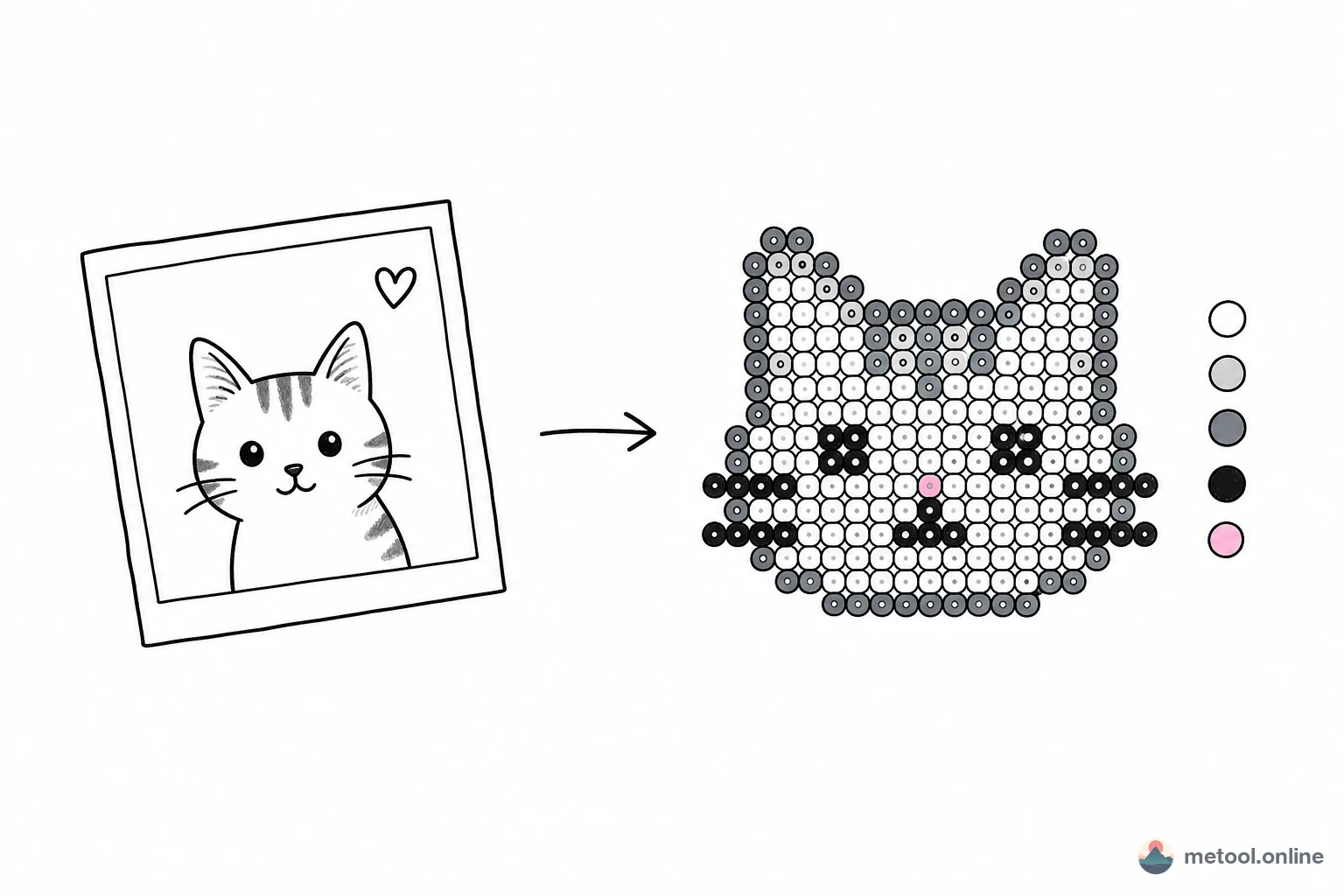
What Should You Look for in a Bead Tool?
Most important isn't conversion quality—kit alignment. Classic tools export colors you didn't buy; pretty patterns you can't build. Judge on three points: mainstream brand chart alignment, limiting to your kit range, one-step shopping list.
Context: fuse beads (Perler/MARD) are placed on boards and ironed together. In China MARD 221-color standard dominates—Taobao kits commonly 24/48/72/96/120/221. Tools off that system export unusable codes.
How Do Mainstream Online Tools Compare?
Differences concentrate on chart coverage, kit tiers, and editing:
| Tool | Brand chart | Kit alignment | Brush edit | Color count | Local processing |
|---|---|---|---|---|---|
| MeTool | MARD 221 | 24/48/72/96/120/221 | Yes | Yes | Yes |
| Pixelbead | MARD 291 | 72/96/120/144/221 | Yes | Yes | Yes |
| 拼豆酱 | MARD / Artkal / 黄豆豆 | By brand | No | Yes | Yes |
MeTool aligns six common Taobao tiers—low barrier; Pixelbead has fullest chart (extended series) for advanced; 拼豆酱 multi-brand for cross-brand matching. Details below.
221 Colors Enough, or 291?
For most people MARD 221 is enough—A–M standard series, matches mainstream kits, codes (A5, B8, H7…) match physical charts—export directly for shopping.
291 (P/Q/R/T/Y/ZG extensions) adds finer color steps—complex high-fidelity work or users with extended sets. Larger chart → algorithm may pick rare colors you don't own—increasing shopping burden. More colors ≠ better for everyone; match what you'll stock.
Kit Alignment and Shopping Lists—Why They Matter
Directly determines whether the pattern is buildable. Kit alignment: pick "I have 24 colors" → algorithm uses only those 24, never outside. Tiers matching Taobao (24/48/72/96/120/221) → higher match with what you bought.
Color count/shopping list solves restocking—per MARD code usage whether buying full kit or singles. Without kit limits, you might get a pattern using 80 colors when you own 24.
Where Brush Editing Matters
Gap: refine without redoing. Auto-match isn't perfect per cell—wrong code, or want closer color from kit. MeTool and Pixelbead allow per-cell edits from current kit palette; counts update live. 拼豆酱 lacks brush—accept algorithm output or re-tune and reconvert. Quality-focused users need per-cell edit.
Tips for better results:
- Pick the right image: clear outlines, strong contrast (cartoon, logo, pixel art)—complex photos need 72+ grid.
- Match kit when generating: 24-color kit → generate with 24—cleaner, no impossible codes.
- Grid guides: 10-cell spacing aligns with 29×29 standard board sections.
- Directional designs: flip before generate—ironed front/back are mirrors; text/direction matters.
Which Tool for Which User?
- Beginner/hobbyist, export-and-buy, fewer pitfalls: perler pattern generator—six tiers matching Taobao kits.
- Advanced, full extended colors, high fidelity: Pixelbead MARD 291.
- Cross-brand (Artkal, etc.): 拼豆酱.
Summary
Image-to-bead: "can convert" is baseline—"codes match what you own" is the real divider. Check MARD alignment, kit limiting, per-cell edit, shopping list. Hobbyists: kit-aligned, brush-capable online perler tool; advanced: Pixelbead; cross-brand: 拼豆酱. Know which box you have first—tool adapts to you, not the reverse.