Renju forbids apply only to Black: if one move simultaneously creates two open threes (double-three), two fours (double-four), or a line of six or more (overline), that point is forbidden—playing there loses immediately. An exact five-in-a-row is still a legal win. White is not bound by these three fouls.
Why Do Freestyle Gomoku and Renju Bring Up “Forbidden Moves”?
Freestyle Gomoku is minimal: players alternate stones; first to get five in a row horizontally, vertically, or diagonally wins; Black moves first; there are no forbids. At high level on a large enough board, Black’s first-move edge can approach a forced win. Competitive Renju therefore adds forbidden moves for Black to pull that advantage back toward fairness.
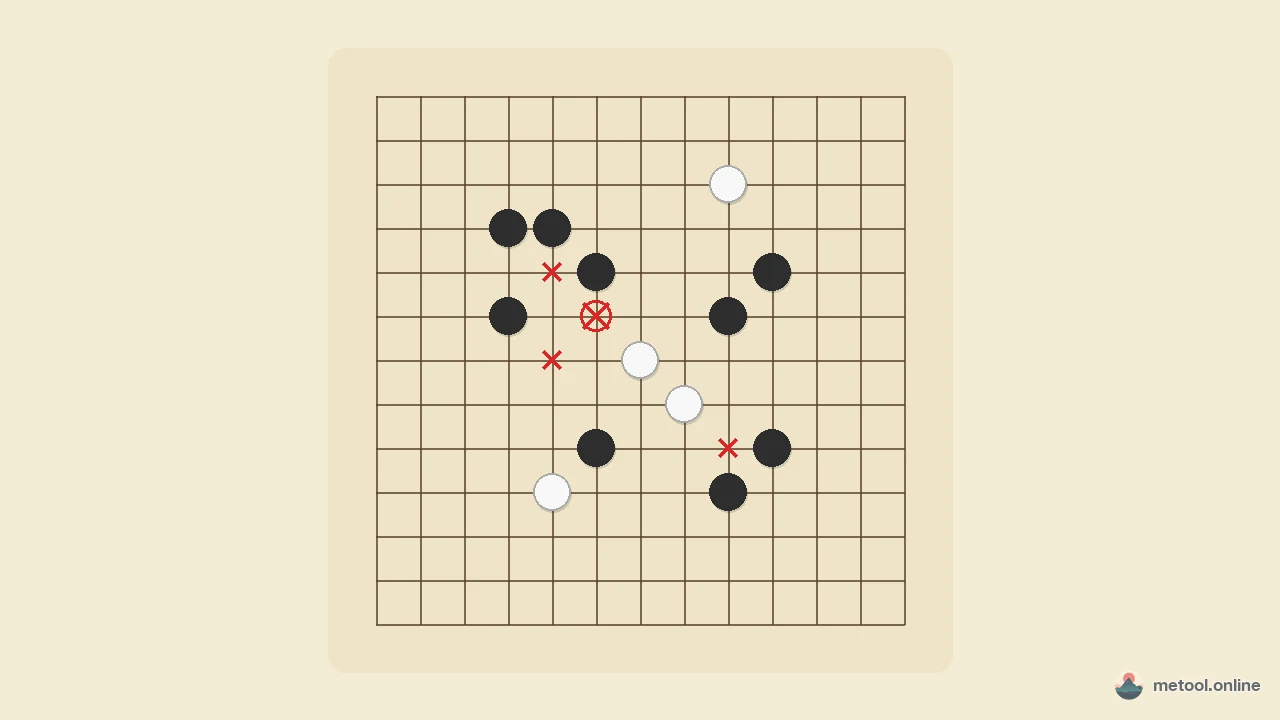
A “forbid” is not “you cannot click the intersection.” It means: if Black places a stone there, Black loses at once (White wins). Software often marks current forbidden points with a red X; Black may still mis-click—then the UI reports a foul and ends the game.
| Rules | Black forbids | White forbids | Typical use |
|---|---|---|---|
| Freestyle Gomoku | None | None | Casual, beginners, blitz |
| Renju | Double-three / double-four / overline | None | Competition, training, fairer matches |
| Local “pseudo-Renju” variants | Details may differ | Usually none | Agree on the rulebook before kickoff |
International Renju uses a 15×15 board; practicing forbid shapes on 13×13 is fine for casual study—the board is tighter, so shapes appear earlier.
What Is a Double-Three? One Move, Two Open Threes
A double-three means Black creates two open threes with a single placement. An open three, intuitively, is a three that can become a clear “four” threat (straight or broken four) on the next move, with openness meeting Renju’s definition. When the same move births two such threes, it is a foul.
The diagram below is a simplified teaching figure: blue and orange bands mark the two forming threes; the crossing empty point is marked with a red X—if Black plays there, one move completes both a horizontal and a vertical open three.
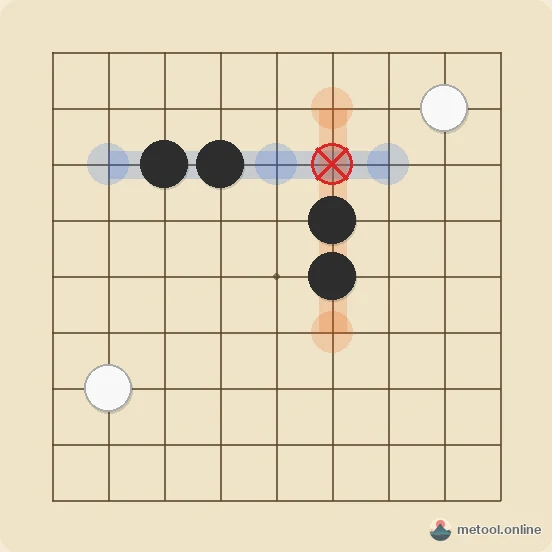
When reading the figure, keep three points in mind:
- Count open threes, not “any three stones”: a three blocked by White that cannot become a four usually does not count;
- Both must come from the same move: having one open three already, then making another later, is generally not a double-three;
- White may deliberately make double threes: forbids punish Black only; White attacking with two open threes is legal.
In real games, double-threes often sit at “diagonal bloom” or right-angle crossings—one point controlling two lines—which is why UIs like crossing highlights.
What Is a Double-Four? One Move, Two Fours
A double-four means Black creates two “fours” with a single placement (open fours, straight fours, etc., as defined by the rulebook). A four is closer to winning: the opponent usually must answer. Creating two fours at once means White cannot block both, so Renju forbids Black from doing it.
In the figure, three stones sit horizontally to the left and three vertically above; the crossing empty point, if filled by Black, makes two fours at once (blue/orange bands).
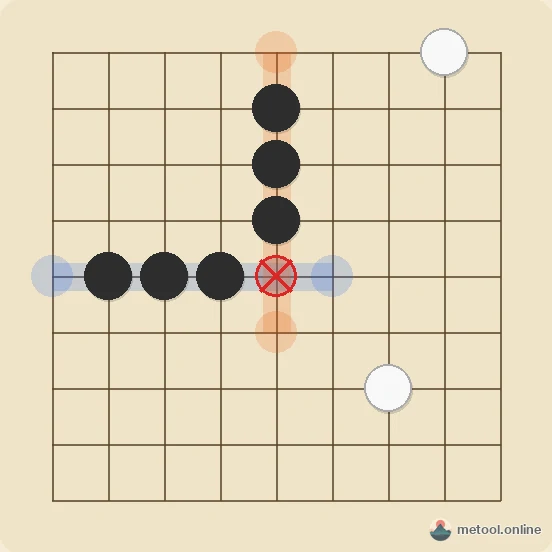
Compare with double-three:
| Foul | One move creates | Threat level | Common beginner mix-up |
|---|---|---|---|
| Double-three | Two open threes | One more move to reach a “four” | Counting dead or fake threes |
| Double-four | Two fours | Already forcing replies | Calling a “four-three” a double-four |
| Overline | Six or more in a row | Immediate foul | Thinking “longer is better” |
A four-three—one four plus one open three in a single move—is usually legal in Renju (follow your rulebook) and still very strong; do not conflate it with double-four or double-three.
How Does Overline Differ From an Exact Five?
An overline foul means Black’s move creates a line of six or longer and loses. Freestyle habits of “connect as long as possible” make it easy to overshoot once forbids are on.
The figure below: before the move the shape is “four stones + gap + one stone” (longest run is four—no five-in-a-row win yet). Filling the gap at the red X makes six at once—that is the overline foul, not “already five, then one more beyond.”
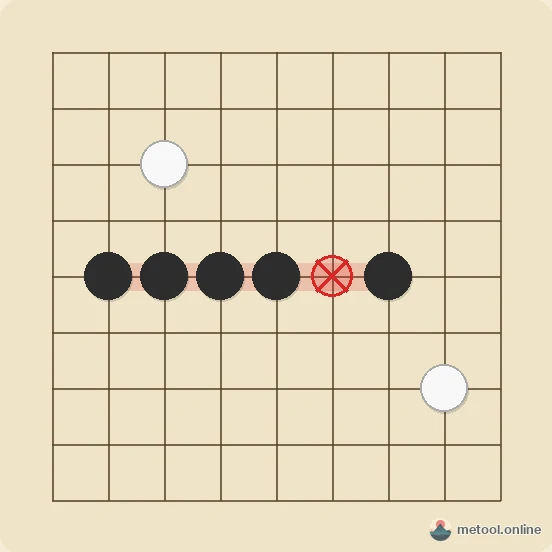
Contrast with the next figure: in the same direction, completing exactly five (green ring) is a legal win.
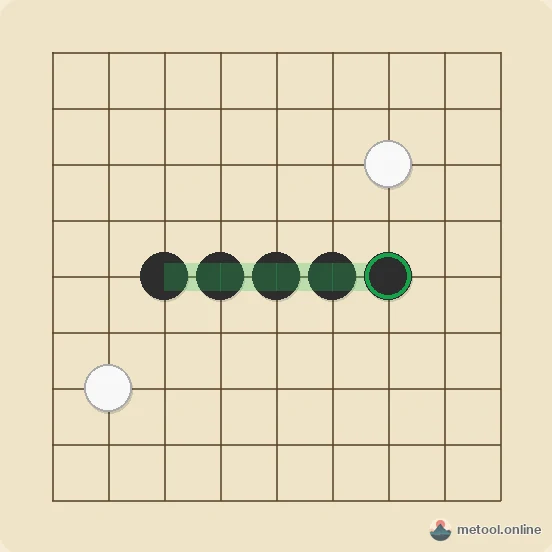
A short mnemonic: Black wants exactly five; one more and it backfires. White has no overline foul—in Renju White already wins with five, so longer lines are usually moot. Practice Black’s “stop cleanly” habit: count the length after the candidate move, not only whether White is blocked.
How Do You Tell If a Point Is Forbidden?
Use a fixed three-step check instead of memorizing every shape:
- Imagine Black plays on that empty point (mental trial only);
- Count separately: ≥2 open threes? ≥2 fours? a run of length ≥6?;
- Any yes → forbidden. As a learner you need not enumerate every rare pattern: modern Renju engines mark Black’s current forbidden points. What you train is decision-making when you see the red X—steer the attack around forbids, or use forbid structure to push Black onto second-best points.
One easy boundary: an exact five is a legal Black win; if the same move makes six or more, it is an overline foul. When unsure, trust the engine marks and the rulebook for your game.
How Can You Practice These Shapes in the Browser?
To turn diagram red X’s into instincts you can dodge—and use—open Renju mode on the site’s Gomoku page: go to online Gomoku, set difficulty to Heaven, and turn on Renju forbids (13×13 or 15×15). When it is Black’s turn, forbidden points are marked; if you play Black and hit one, you get a foul notice and lose—handy for checking the three shapes above.
Suggested practice order:
- Play White first: let the engine take Black; watch how it avoids red X’s and how forbid structure pressures you;
- Then play Black: in the early–middle game, deliberately watch the marks and force yourself to find attacking points that are not fouls;
- Shape drills: set up double-three / double-four / overline skeletons, check whether engine marks match your expectation, then try legal mates that are “one intersection off” from a foul.
For casual freestyle, turn the switch off—rules return to no-forbid Gomoku without affecting other difficulties.
Takeaways: Three Sentences Are Enough to Start
- Forbids punish Black only: double-three, double-four, overline; White has none of these three.
- Core intuition: Black may not create two unstoppable killing structures in one move, nor make six or more in a row.
- Five wins, six fouls: count length when finishing; when unsure, read the red X’s and practice in Gomoku Renju mode.