"Invisible yet proves the image is mine"—blind watermarks sound like magic. After WeChat forwarding, screenshots, rotation, and crops, will they still detect? Answer: which algorithm and what attacks. Understanding where data hides and what breaks them tells you if they fit your scenario.
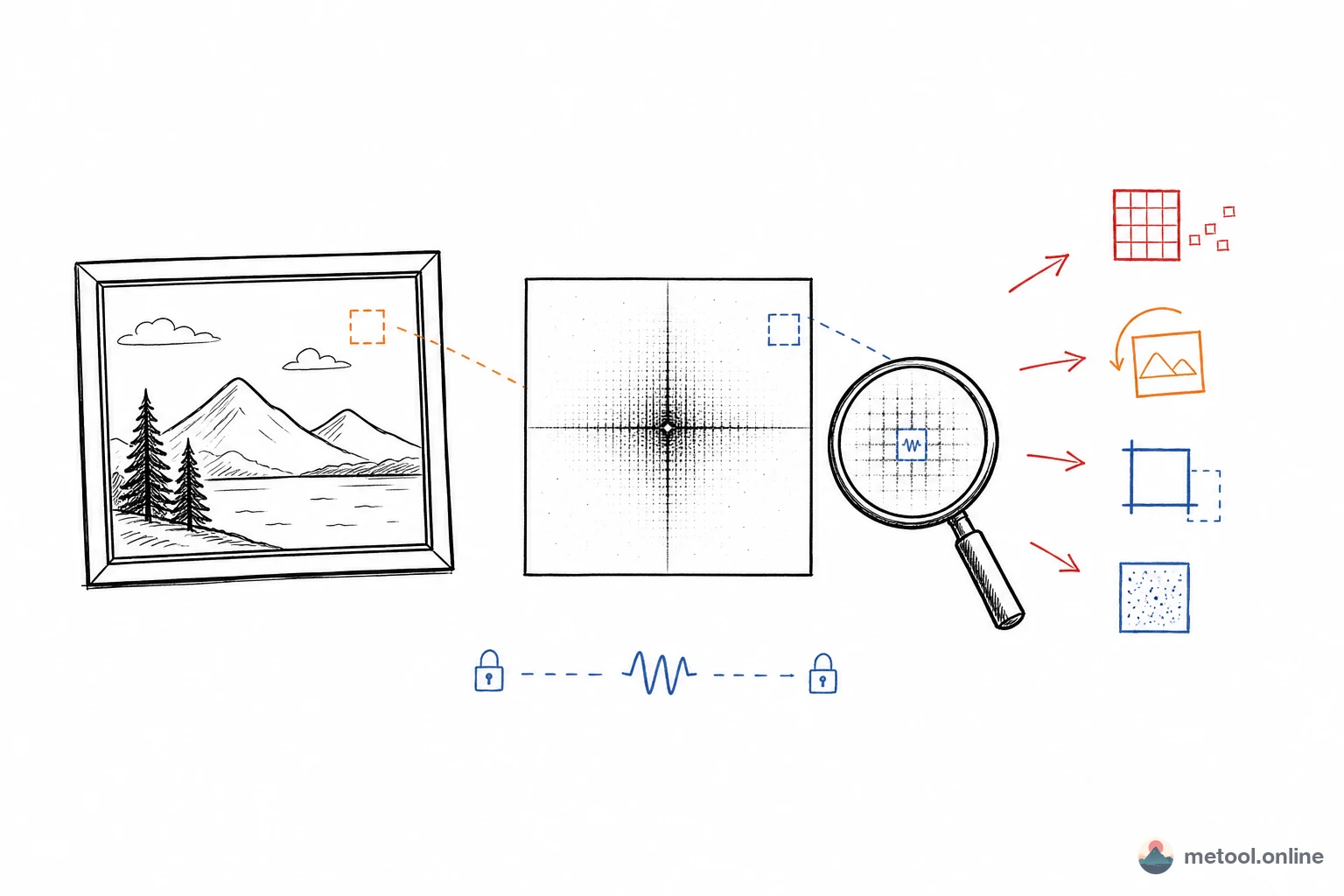
Where Do Blind Watermarks Hide Information?
Blind watermarking hides data in the image without needing the original to extract or verify. The key isn't "how deep" but hiding where the eye is insensitive and processing is less destructive. Two fundamental routes:
- Spatial domain: change pixel values directly—e.g. LSB. High capacity, easy to implement, very fragile—any compression or scale destroys it.
- Frequency domain: transform to frequencies, tweak coefficients. Lower capacity, much better tolerance to compression and noise.
Practical blind watermarks almost always use frequency domain—next section ties "invisible" and "compression-resistant" to the same choice.
Why Frequency Domain Stays Invisible and Resists Compression
Human vision and JPEG compression treat frequency components very differently. After DCT (Discrete Cosine Transform) or DWT (Discrete Wavelet Transform):
- Low frequency: overall brightness, large color blocks—eye is sensitive; changes show.
- High frequency: detail, edges, noise—eye insensitive, but JPEG drops high frequency first.
- Mid-low frequency: compromise—eye relatively insensitive, compression reluctant to discard.
Blind watermarks embed in mid-low coefficients: tiny amplitude—invisible after inverse transform (imperceptibility); compression keeps mid-low—moderate JPEG often preserves signal (robustness). Invisibility and compression resistance come from the same frequency choice.
Robustness vs. Capacity vs. Invisibility: A Tradeoff Triangle
Blind watermarks face a triangle—tuning one affects the others:
| Goal | Approach | Cost |
|---|---|---|
| More robust (compression/noise) | Larger embed amplitude, lower frequencies | More visible, less capacity |
| More invisible | Smaller amplitude | Weaker under compression |
| More capacity (more text) | More coefficients | Diluted amplitude per point, weaker robustness |
No watermark is "high capacity, fully invisible, and bulletproof." Capacity scales with image size—large images hold more; small or large flat areas (sparse coefficients) limit embed; forcing embed overflows or hurts quality.
The Hard Opponent: Geometric Attacks
Frequency watermarks have a natural weak spot—geometric attacks: rotation, scale, crop, translation. Extraction depends on coefficient-position alignment; rotate 5° or crop an edge and coefficients misalign—standard frequency watermarks fail. Unlike JPEG's "amplitude decay," this is a different attack class.
Counter: Fourier magnitude spectrum embedding—magnitude spectrum rotates/scales with image rotation/scale; embed as rotation/scale-invariant ring structure to detect after transform. Clear tradeoff:
Geometric-attack algorithms usually answer "does this image have my watermark" (existence)—hard to recover embedded text. Readable text → standard frequency text watermark; rotation/scale resistance → magnitude fingerprint—often layered.
Practical schemes often offer both: readable text (DWT-DCT-SVD class—extract content, resist noise/compression) and rotation/scale fingerprint (Fourier ring—presence only). Pick by feared attack; stack when needed.
Limits: What Blind Watermarks Don't Guarantee
Set expectations to avoid misuse:
- Not encryption: watermark carries ID/copyright, not content secrecy.
- Repeated re-compression: each forward compress erodes signal—long chains may fail; verify on original exported PNG, not chat-compressed copies.
- Transparency and large flat areas: transparent pixels and near-white blocks can't carry coefficient perturbation—embed may fill background or tint slightly.
- Don't prevent theft—enable forensics: provenance/evidence, not access control.
- Strong adversaries can remove: targeted denoising, resampling, AI repaint may erase watermark.
When Does This Technology Fit?
Judge by what processing the image will undergo and whether you need readable content vs. existence proof:
- Fits: controlled original distribution (export PNG to recipient), post-hoc trace/proof, copyright/leak scenarios tolerating slight quality change.
- Marginal: multiple social-platform recompressions—compression-resistant algorithms help but detection rate drops.
- Poor fit: content secrecy (use encryption), or severe geometry/AI repaint while needing 100% readable recovery.
Summary
Blind watermarks hide in mid-low frequency coefficients—eye insensitive there, JPEG reluctant to discard—yielding invisibility and moderate compression resistance. They can't escape the robustness/invisibility/capacity triangle; geometric attacks (rotate/scale) need Fourier magnitude invariants at the cost of presence-only verification. Forensics and proof tool—not encryption, not erasure-proof—best when originals are controlled and ownership must be demonstrated.