In Reversi, players alternate on an 8×8 board: you must “sandwich” a run of opponent discs between two of yours so they flip to your color; at the end, the side with more discs wins. The rules take minutes to learn; the hard part is building stable discs for the endgame.
How Is the Reversi Board Set Up? Where Are the Opening Four Discs?
Standard Reversi (also called Othello) uses an 8×8 board with 64 squares. The center four squares start occupied—two black, two white, same colors on diagonals: white on the upper-left and lower-right of the center block, black on the other diagonal (same as the opening of the online Reversi page). Black moves first.
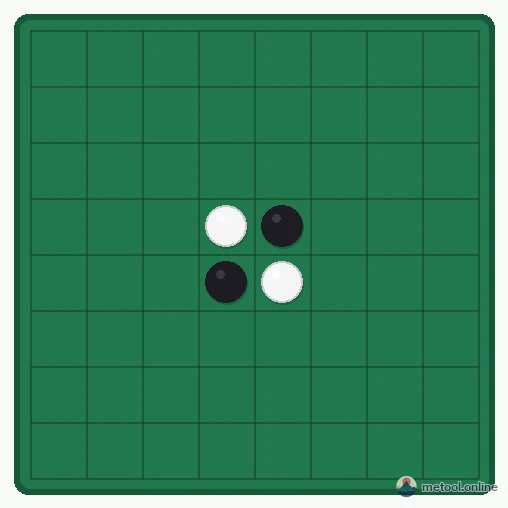
Remembering this shape helps: every legal move grows from these four discs by looking along lines that can sandwich the opponent. Captured discs do not leave the board—they only change color—so games often finish with a full or nearly full board counted by discs.
What Does “Sandwich” Mean? How Are Flips Decided?
A flip is a sandwich on a straight line: after you place on an empty square, look in one direction—first you meet one or more consecutive opponent discs, then a disc of your own. Those opponent discs all flip to your color. Directions include horizontal, vertical, and diagonal—eight in total—and each is judged separately.
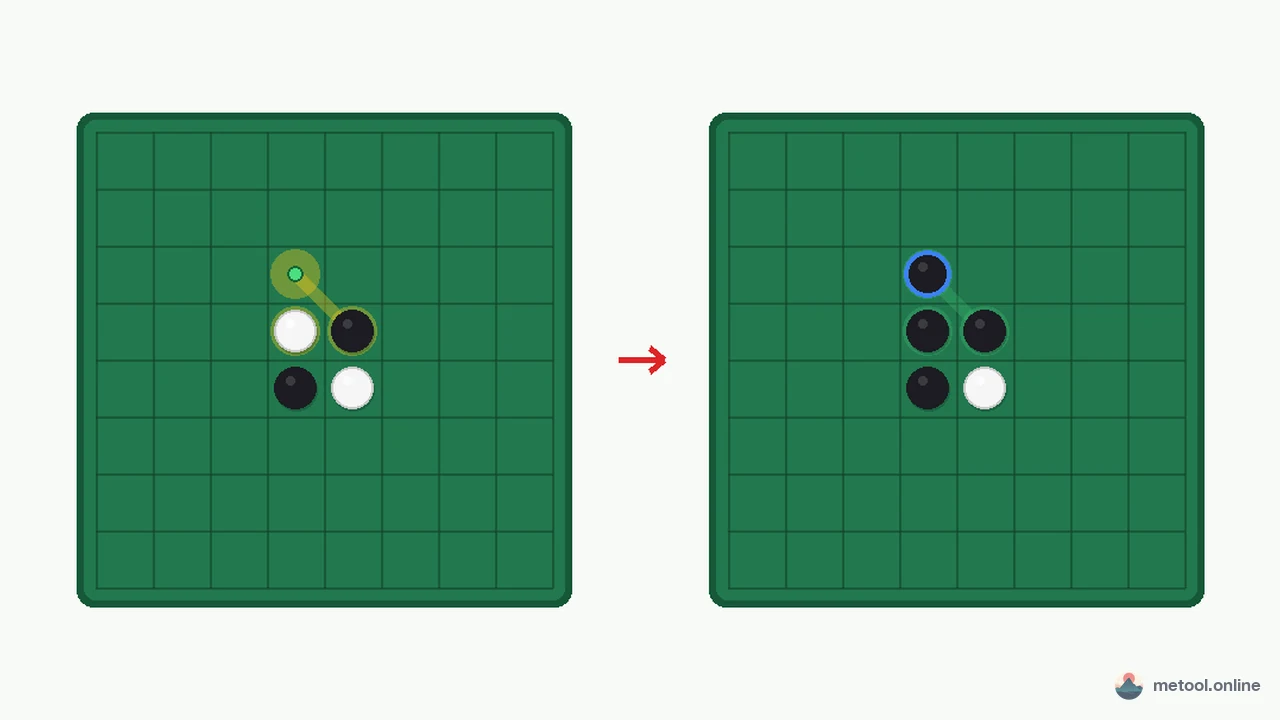
On the left below, Black is about to play on the green dot above; the yellow band marks the vertical sandwich “new black — white — existing black.” On the right, the new disc has a blue ring and the middle white disc has flipped to black.
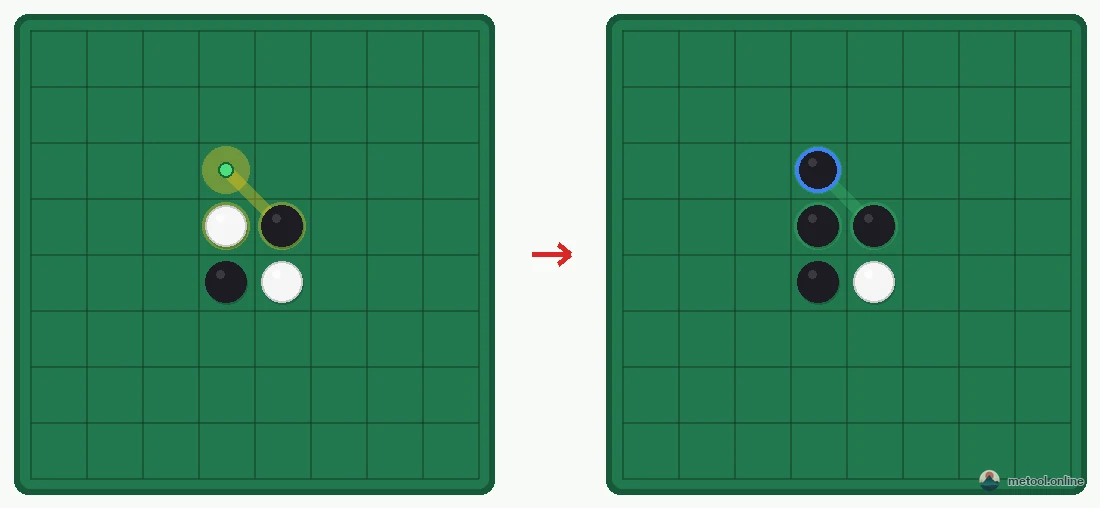
The looping demo shows the same sequence: green dot pulses → place → the white disc flips to black (muted autoplay).
When reading the figure, keep three points in mind:
- Both ends must be yours: only your color—opponent—your color counts; if the far end is empty or off the board, that ray does not flip;
- The middle may be one or more opponent discs, consecutive, with no empty gaps;
- At least one flip is required: if none of the eight directions flips anything, the square is illegal.
What Are the Opening Legal Moves? What Do the Green Dots Mean?
At the opening, Black has exactly four symmetric legal squares—above, left, right, and below the center block. Software often marks every legal square for the side to move with a green dot—the dots are legal moves, not decoration.
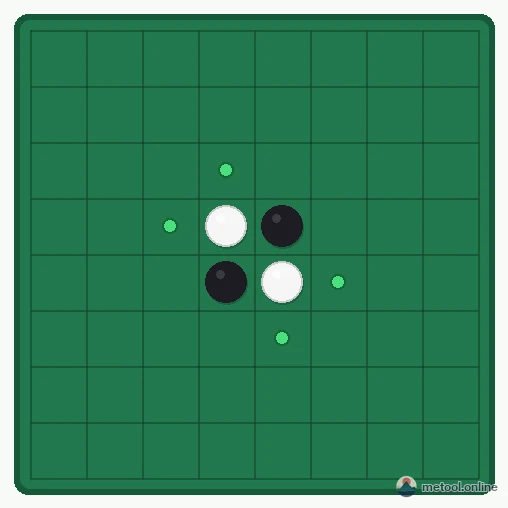
The demo highlights the four dots in turn, then plays one of them through to the flip—the same “green = playable” feedback as on the play page.
A quick reference:
| Situation | Can you play? | Result |
|---|---|---|
| Empty square that sandwiches opponent discs on at least one line | Yes | Place, flip, opponent to move |
| Empty square with no sandwich in any direction | No | Illegal |
| Occupied square | No | No stacking |
| No legal moves anywhere for you | — | Pass this turn |
Do not play “next to the opponent” by feel: adjacency is not a sandwich. Check that one of your discs seals the far end before you place.
Can One Move Flip Several Directions at Once?
Yes, and it is common. The new disc scans all eight directions; every ray that forms a sandwich flips all opponent discs on that ray.
The figure below is a teaching position (not a real opening): before Black plays the center blue-ring square, yellow and orange bands mark horizontal and diagonal sandwiches; after the move, whites on both lines become black.
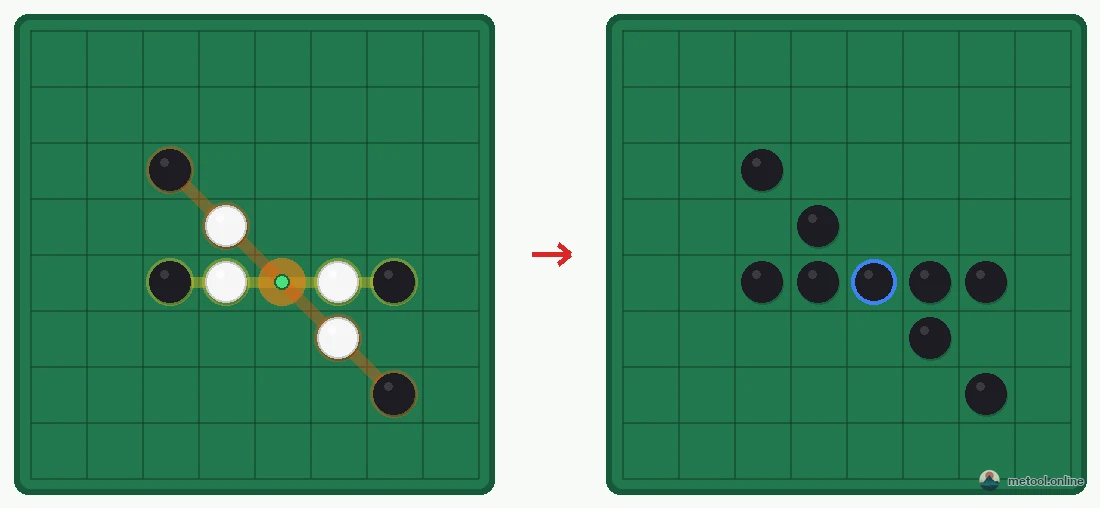
In the clip, four white discs flip together—that is the intuition for multi-direction flips.
In practice you may think you took one disc while a diagonal holds more—count the whole board after the move, not a single ray. On defense, check whether the opponent’s landing square blooms in several directions.
Do You Pass With No Moves? How Do You Win?
If a player has no legal move, that player passes and the other continues—this is not a resignation. The game ends when either:
- All 64 squares are filled; or
- Both players have no legal moves (empty squares can remain if neither can sandwich).
Compare disc counts at the end—more discs wins; equal counts are a draw. A midgame lead in disc count is not the same as an advantage—Reversi often rewards “fake fat”: unstable edge discs get flipped back in bulk near the end.
| Phase | Watch more of | Common mistake |
|---|---|---|
| Opening | Legal moves, keeping options (mobility) | Greedy captures that let the opponent steer the board |
| Middlegame | How you approach edges and corners, stable discs | Hugging the corner too early, gifting the corner |
| Endgame | Exact disc counts, order of filling empties | Assuming a midgame lead will coast to a win |
Why Are Corners Stable? Why Are X-Squares Dangerous?
Once a corner is taken, the opponent usually cannot sandwich it from outside—there are no squares beyond the corner. Corner discs are typically stable: they stay yours and often nail down nearby edge discs. Beginner advice starts with: take corners, and do not help the opponent take them.
Blue marks the four corners; red marks the diagonal neighbors often called X-squares. Playing an X-square early often lets the opponent walk into the corner along a diagonal or edge—you opened the door.
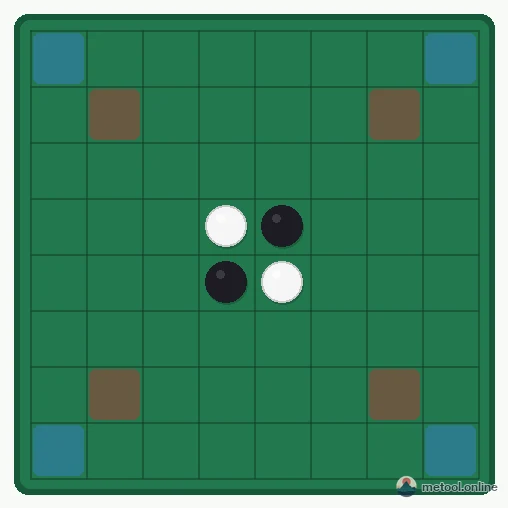
Teaching demo: highlight corners and X-squares, then White takes the corner and flips the black disc on the X-square—once a corner lands, it rarely flips again.
This is not absolute: strong players sometimes sacrifice a corner for global mobility. For learners, the safer default is protect corners, avoid X-squares—break the rule only after the basics feel automatic.
How Can You Practice These Diagrams in the Browser?
Turn the figures into muscle memory on online Reversi: you play Black first, green dots show every legal move, and flips animate so you can check which discs changed. Choose Easy / Medium / Hard (different Minimax depths); use Pass when you have no move.
Suggested practice order:
- Only green dots: play only on dots until “legal = at least one flip” is automatic;
- Count flips after each move: compare with the animation to train multi-direction scanning;
- Watch the four corners in the middlegame: ask whether this move gifts a corner;
- Raise the difficulty: after Easy feels clear, try Medium or Hard and prioritize stable squares over raw disc grabs.
Summary: Five Rules Are Enough to Start
- 8×8 board, four center discs on diagonals, Black first.
- A move must sandwich and flip at least one opponent disc; check eight directions.
- One move can flip several lines; illegal squares cannot be played.
- No legal move → pass; both stuck or board full → end, more discs wins.
- Corners are stable, X-squares are risky—build that instinct before deeper theory.
Once the rules are clear, Reversi’s fun is that the same move can feast on discs or pave the opponent’s path. Run through the figures once, then play a game or two—more useful than memorizing jargon.