The Xiangqi rules that actually get misplayed are not opening names. They are three shapes you can point to: a Cannon that only captures with a platform, a Horse that can be blocked, and Horse-behind-Cannon that mates only when the General has no reply.
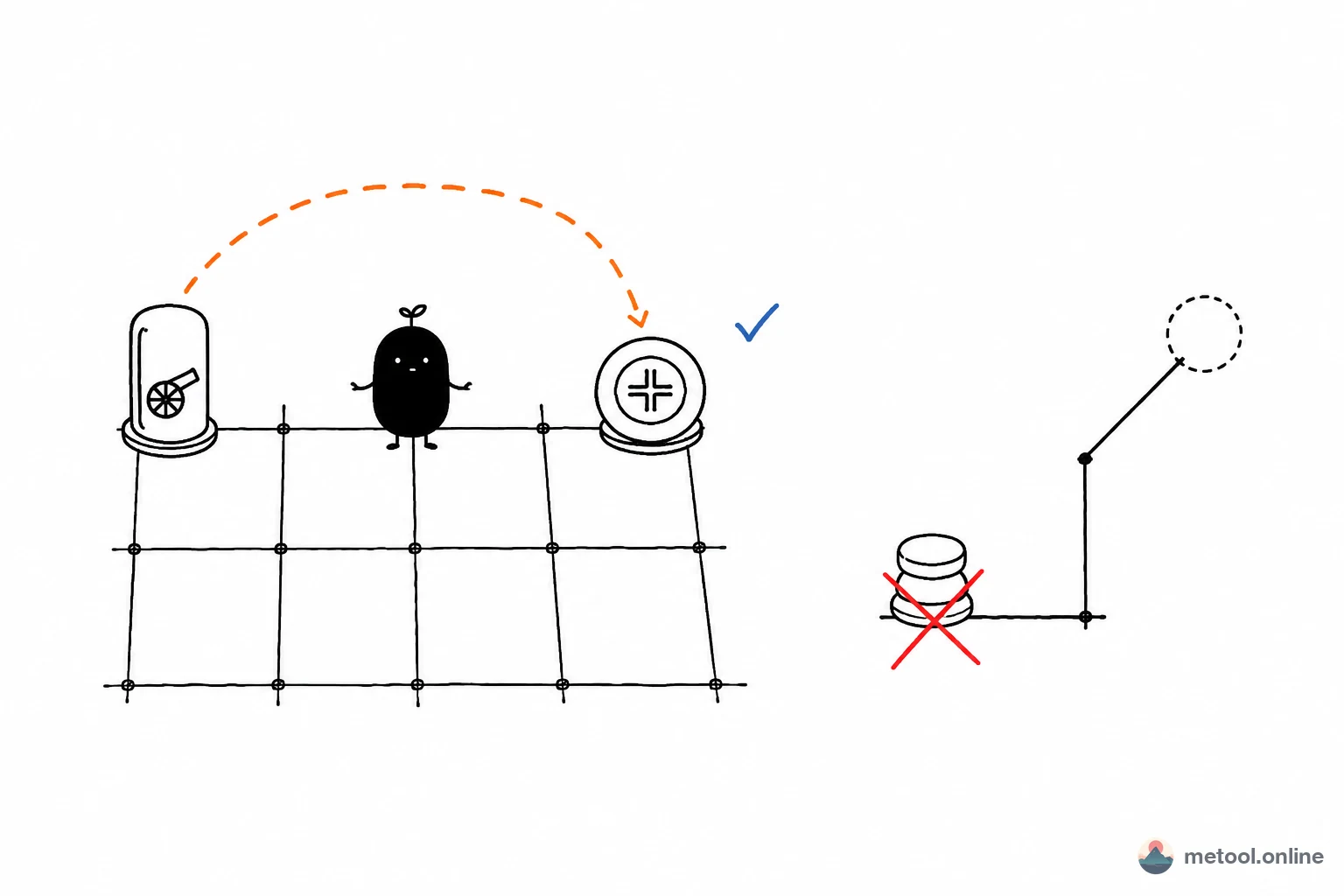
Why does a Cannon need a platform to capture?
When it is not capturing, a Cannon moves like a Rook: any number of squares orthogonally, no jumping. To capture, exactly one piece must sit between the Cannon and the target. That piece is the platform. Two pieces, or none, and the capture is illegal.
International chess has no Cannon. Treating a Cannon like a Rook is stacking two rulesets. In a crowded middlegame platforms are easy to find. In a sparse endgame the same Cannon often “shrinks” because the platform is gone.
Count only the squares on that line:
| Pieces in between | Can the Cannon slide there empty? | Can it capture a piece there? |
|---|---|---|
| 0 | Yes | No |
| 1 (platform) | No | Yes |
| 2 or more | No | No |
A common false read is “my Cannon points at the General, why isn’t that check?” Count the pieces in between. Zero means you are aiming, not checking. Two means the jump is too far.
Which square hobbles a Horse?
A Horse moves in an L: one step orthogonally, then one diagonally. The block is the first orthogonal square. If that square has any piece, the Horse cannot jump that way. The destination may still be an enemy capture if the first step was empty.
A chess Knight is never blocked on the first step. Players who bring that habit into Xiangqi keep trying jumps that are simply illegal.
Three checks are enough; you do not need coordinates:
- Pick the L-shaped destination.
- Look at the orthogonal square the Horse must step through first.
- Empty means the jump is legal; occupied means abandon that direction and try another L.
In endgames, sitting on that first square is a standard defense: the check disappears. The attacker has to look at the same square before assuming the Horse still checks.
When does Horse-behind-Cannon mate?
Horse-behind-Cannon is a coordination, not a piece name: the Horse gives check, and the Cannon sits on the same line, using that Horse as the platform against the General. The Horse checks now; the Cannon keeps the threat if the Horse is captured or the General steps onto the line.
It does not always mate. Mate still requires that the side in check has no legal reply: no flight square, no interposition, no capture of the Horse or Cannon. With Advisors still beside the General, the check is often escaped.
It is more often a mating idea when:
- The General’s sides are blocked by its own Advisors (a smothered-palace shape), so it can only step forward or toward the Horse.
- The Horse’s first step is empty, and the defender cannot occupy it in time.
- Horse, Cannon, and General share one line, with the Horse as the single piece in between.
A related linear rule is the flying general: both Generals on the same file with nothing between them. That setup is illegal at the start of a game. During play, moving the last blocking piece off the file can win immediately. It is not the same pattern as Horse-behind-Cannon, but both depend on whether a file is empty.
Where these three rules fail when you set up an endgame
When you copy a book diagram onto a board, the failure is usually a validator error, not a vague “this feels wrong.”
| Shape you want | Rule that is easy to skip | Check this first |
|---|---|---|
| Cannon check | Exactly one piece in between | Count pieces between Cannon and General |
| Horse check | The first step must be empty | Look at the Horse-block square before the landing square |
| Horse-behind-Cannon | Horse, Cannon, and General colinear | After the Horse is captured, does the Cannon still have a platform? |
| Generals facing or not | Empty file is illegal in setup / winning in play | Are the two Generals on the same file? |
A workable order when placing pieces:
- Place both Generals in their palaces. Do not start with an open file between them.
- Place Horses and Cannons. After each one, use the table above.
- Add Rooks, Pawns, Advisors, and Elephants. Elephants cannot cross the river; Advisors stay in the palace.
- Choose who moves next, then play or turn the position into a link.
To place these shapes in a browser and continue against an AI, use layout mode on the Xiangqi AI page. For “mate in one” drills that only ask whether you missed an interposition, use Xiangqi endgames.
When you should not force Horse-behind-Cannon
If you cannot finish the line, or the General can walk out, do not donate a Rook to complete a pretty shape.
- Count forced checks first. If the opponent has only one reply, play that line before looking for Horse-behind-Cannon.
- Keep the Rook when few pieces remain. Platforms get scarce; a Rook does not need one to own a file.
- Park chess habits. A blocked Horse and a Cannon that cannot capture “through empty air” are not occasional exceptions in Xiangqi.
Treat the three rules as a checklist, not as opening jargon, and both missed mates and missed defenses drop.