You want to learn drums, but a real kit is too expensive and loud, e-drums still cost hundreds, and you don't even know if you'll stick with it. What you actually need first isn't to "buy all the gear" — it's to understand what drumming really trains, and which of those skills need no real kit at all. Get that straight and you can take the first step at zero cost, while avoiding an impulse buy that ends up gathering dust.
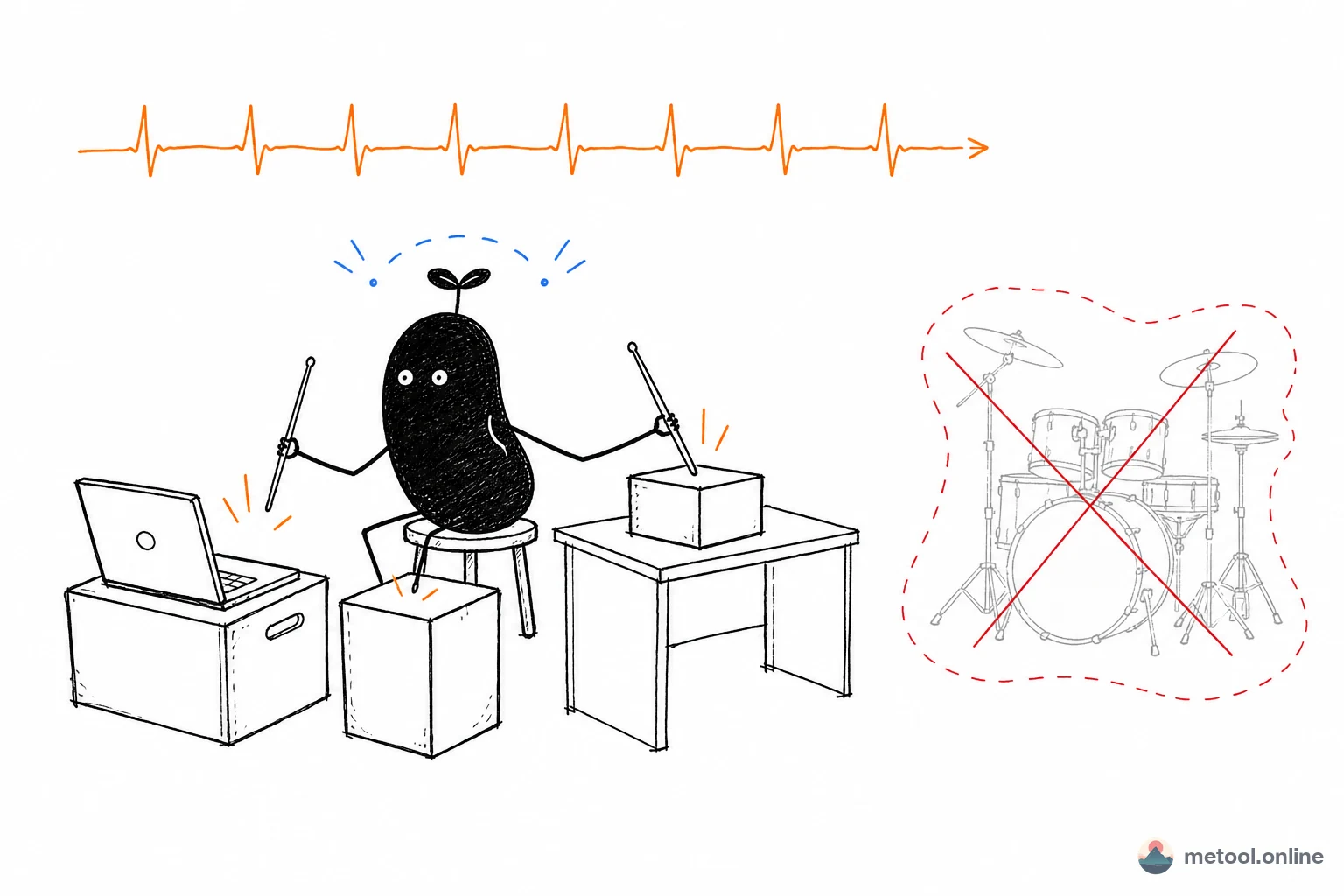
What's actually hard about drumming? Not power — it's staying steady
The core difficulty of drumming isn't hitting the drum hard, it's landing every stroke on the exact right moment and holding an even tempo for a long stretch. Beginners assume drumming is about power and speed, but the real dividing line is "timing": can you spread a groove evenly across several minutes, with no click track, without speeding up or dragging?
The key insight here is that timing is pure neural training and barely depends on what you're drumming on. Tap with your fingers on a desk, with chopsticks, or on a keyboard — as long as the moment of each hit is right, you're training the same "internal metronome." That's exactly why "you can practice without a real kit" holds true: the hardest, most valuable part of drumming happens to be the part least picky about gear.
With no real kit, what can you train and what can't you?
Without a real kit, rhythm-related skills transfer fully, while feel-of-impact skills don't. Break the skills apart and the boundary is clear:
| Skill | Trainable without a real kit? | Note |
|---|---|---|
| Timing stability | ✅ Yes | Pure neural training; fingers/keys work if the timing is right |
| Hand-foot / limb independence | ✅ Yes | Multi-touch or "keyboard + space as kick" simulates splitting limbs |
| Groove memory & phrase structure | ✅ Yes | Memorize the basic beat, fills, and how to cap a phrase |
| Names & timbres of each drum | ✅ Yes | Ear-train snare/tom/crash; build an audio map |
| Striking dynamics & rebound feel | ❌ No | Needs a surface with physical rebound |
| Hi-hat / kick pedal footwork | ❌ No | Needs a real pedal |
The takeaway is practical: 80% of the beginner difficulty (steadiness, coordination, memory) sits in the "trainable" column. Once those click, tackling the "last 20%" — dynamics and footwork feel — is actually most efficient.
What is an online drum kit best used for?
An online drum kit is best for repeatedly polishing grooves and checking whether your tempo holds steady. Its advantage isn't "feeling like a real kit" — it's zero barrier + instant feedback: open the page, put on headphones, and play; on a computer you can use keyboard keys (lower latency than touch, good for tempo work).
The most valuable thing to drill with it is self-correction via record-and-playback. While you're playing it's hard to notice whether you're rushing or dragging, but record that take and loop it, and the problem jumps out instantly — which hit came early, which was weak, you'll hear it in one pass. This "play, then immediately replay and compare" loop is one of the most effective ways to train timing, far more useful than just bashing away nonstop.
Concretely, practice like this: lay down an even closed-hat eighth-note line (map it to one fixed key on a computer), play the kick (space) on beats 1 and 3, and the snare on 2 and 4 — that's the most basic pop groove. Drill them slowly and separately, then combine, record, and loop to confirm every hit is on the grid. To level up, add a high-to-low fill across the high/mid/floor toms at the end of every four bars, then cap it with a crash. The online drum kit makes the whole kit clickable/keyboard-playable with built-in record-and-loop, covering exactly this practice routine.
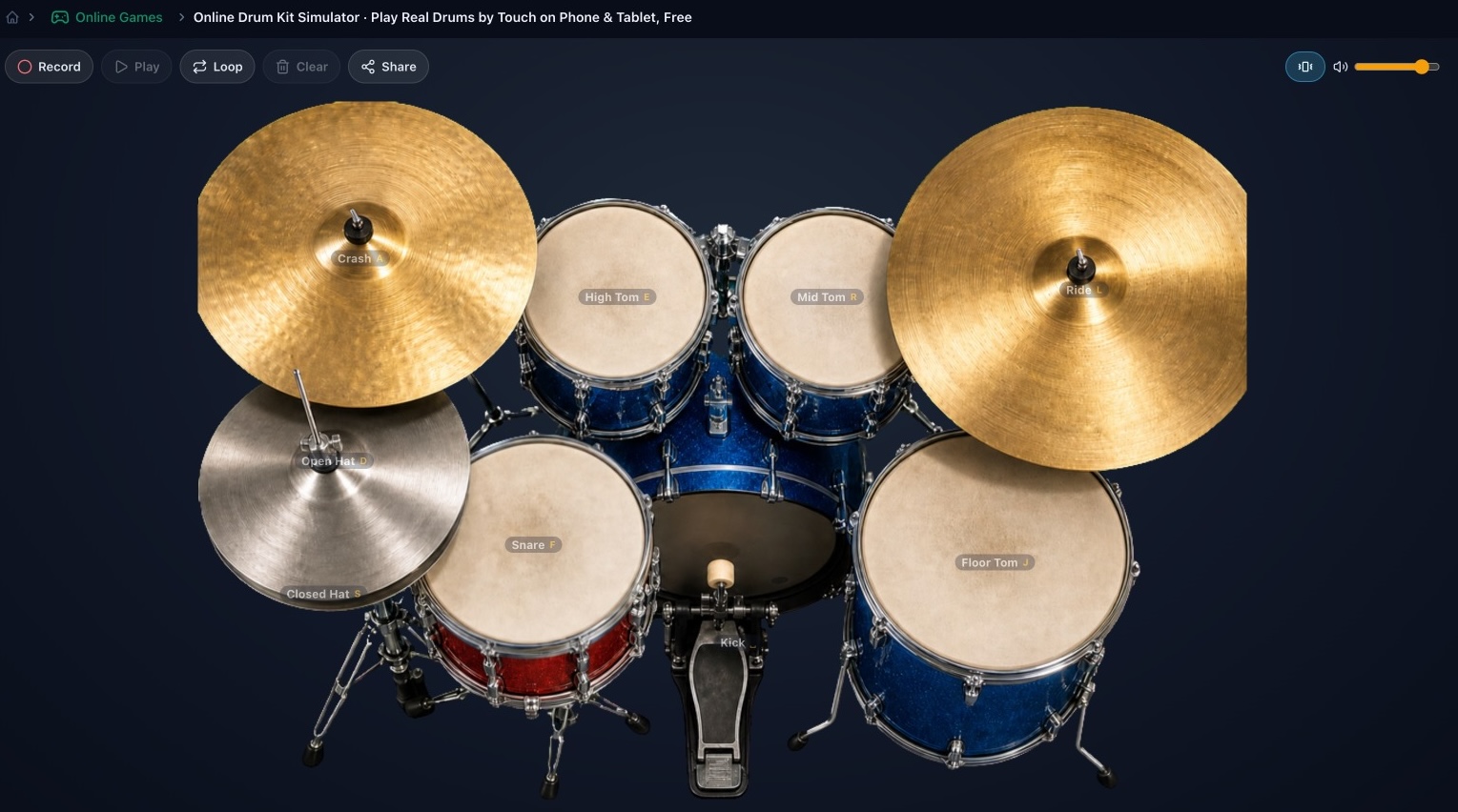
Every drum is labeled with its mapped keyboard letter (crash, snare, kick, toms…), and the Record / Play / Loop controls in the top-left are exactly the self-correction loop described above.
How to choose by budget and stage?
What gear to practice on depends on which stage you're at and how much you're willing to invest — not "more expensive is better":
| Stage / budget | Recommended gear | Mainly trains |
|---|---|---|
| Total beginner, unsure you'll stick with it | Online drum kit / tapping on a desk | Timing, limb independence, groove memory |
| Want to drill striking but need quiet, on a budget | Practice pad | Two-hand rebound and even strokes |
| Committed to learning long-term, can invest | E-drums | Dynamic layers, footwork, full-kit feel |
| Have space and don't mind the noise | Acoustic kit | Real timbre and complete feel |
The sensible path is left to right: first confirm your interest and lock in rhythm fundamentals at zero cost, then upgrade gear step by step to fill in the physical feel. Doing it backwards — buying a real kit first — often leads to quitting, because "it's too loud to dare play, and without the basics you can't play anything anyway."
Where are the limits of this approach?
Honestly, neither an online drum kit nor a practice pad replaces the last mile of a physical kit. When you need to drill loud-vs-soft contrast (accents), rebound control on fast consecutive single strokes, or the footwork stamina of a double-kick — those must be done on gear with physical rebound; a screen or desk gives you no tactile feedback.
So its role is clear: use it for getting started and daily groove review — zero cost, anytime, anywhere; but to truly go deep toward "really playing drums," it's a stepping stone, not the destination. Treat it as the first step — "get your brain and tempo dialed in first, then let your hands and feet catch up" — and you're using it right.
Summary
You can learn drums without a real kit, as long as you recognize that the hardest parts of drumming — steadiness and coordination — happen to be the parts least picky about gear. Beginners should first lock in rhythm fundamentals at zero cost with an online drum kit or pad, self-correcting via record-and-playback; once you're committed and need dynamics and footwork, upgrade to e-drums or a real kit. Don't let "not having all the gear" be your excuse not to start — the part you should train first is one browser tab away.